

The Simple Rule of Three can solve nearly half of the problems encountered in daily life and on exams. The issue is that many people get confused when it comes to “cross-multiplying” the numbers. You will learn an infallible visual method to set up and solve any Rule of Three problem—without having to memorize tedious tables!
Do you want to learn how to set up and solve any Rule of Three problem without the fear of making a mistake? You’ll discover the definitive method for determining whether a relationship is “direct” or “inverse”—no complications involved. Let’s get started!
What Is a “Quantity”?
Before you start cross-multiplying, you need to understand what you are actually measuring. A “quantity” (or variable) is anything that can increase or decrease—such as time, money, or the number of people. The secret to the Rule of Three lies in analyzing how one quantity behaves when the other changes.
DIRECTLY Proportional Quantities
If one increases (↑), the other also increases (↑).
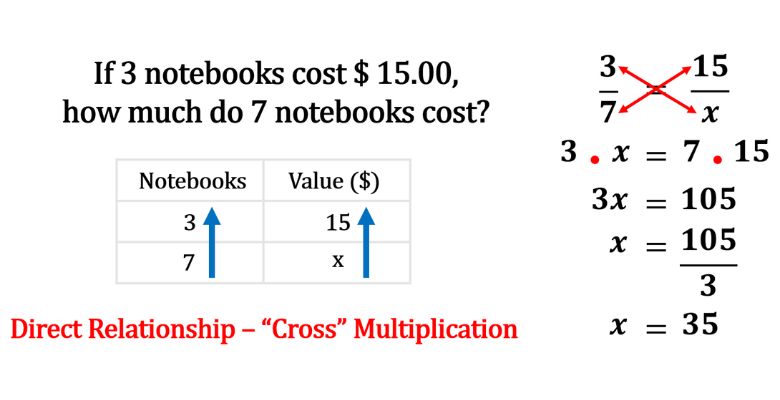
Example: If 3 notebooks cost $ 15, how much do 7 notebooks cost?
If I buy MORE notebooks, I will pay MORE money. Both quantities increase—meaning both arrows point upward—so the relationship is DIRECT! In a direct relationship, you cross-multiply:
ATTENTION: INVERSELY Proportional Quantities
If one increases (↑), the other decreases (↓).
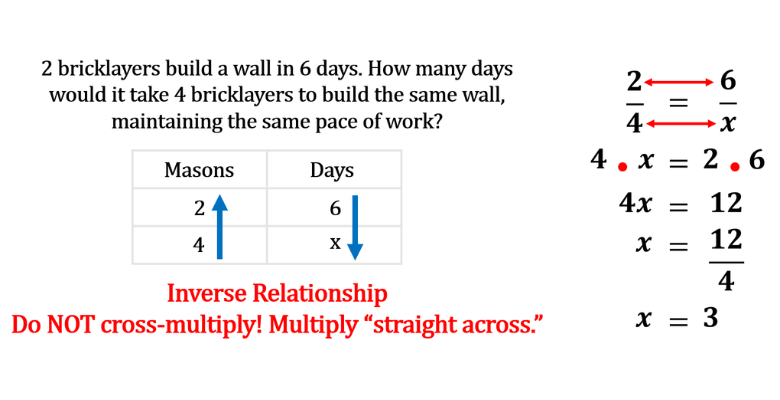
Example: 2 bricklayers build a wall in 6 days. How many days would it take 4 bricklayers?
Be careful here! If I add MORE bricklayers to the job, it will take LESS time to finish. When one quantity goes up and the other goes down, the relationship is INVERSE! In such cases, instead of cross-multiplying, you multiply straight across in a direct line.
Quick Guide: Determining Whether a Relationship is Direct or Inverse
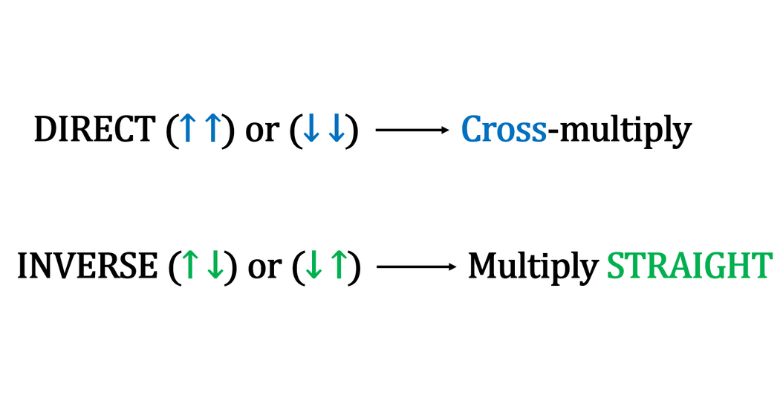
Here is the summary that will help you get any question right:
- If both quantities move in the same direction, cross-multiply.
- If they move in opposite directions, multiply straight across.
Video Lesson – Simple Rule of Three
Check out my video lesson on the simple rule of three, covering both directly and inversely proportional relationships.
4,000 Math Exercises with Answer Keys + Video Lessons. CLICK HERE!
Happy studying! See you next time! Professor Silvio
Deixe um comentário